Herding in Public
感生8: love-based pastoralists, public pasture management, useful-ish theories

This week was the most packed in my time in Dzoge.
I returned to Shangrire for 2 days to spend time and do interviews at Lanmuzhuoma's family members' pastures. Then I spent 3 days back at Zhaqiongcang center, hanging out with the extended family and synthesizing all the notes feelings and thoughts into what I want to discuss with them before I leave. It was really sweet to spend the afternoons, when hostel and restaurant is empty, around the cafe table. I am diagramming, Lemu is learning english vocabulary, Lanmuzhuoma is feeding the baby, Shutu is reviewing plant photos, Yimcuo is playing the virtual boyfriend game, Tenzin is playing chinese Minecraft. Finally I spent 2 days at Maqu, to go with my friend Tingting to do interviews at one of the rare communities that still manage their pasture collectively as a production team instead of as individual households.
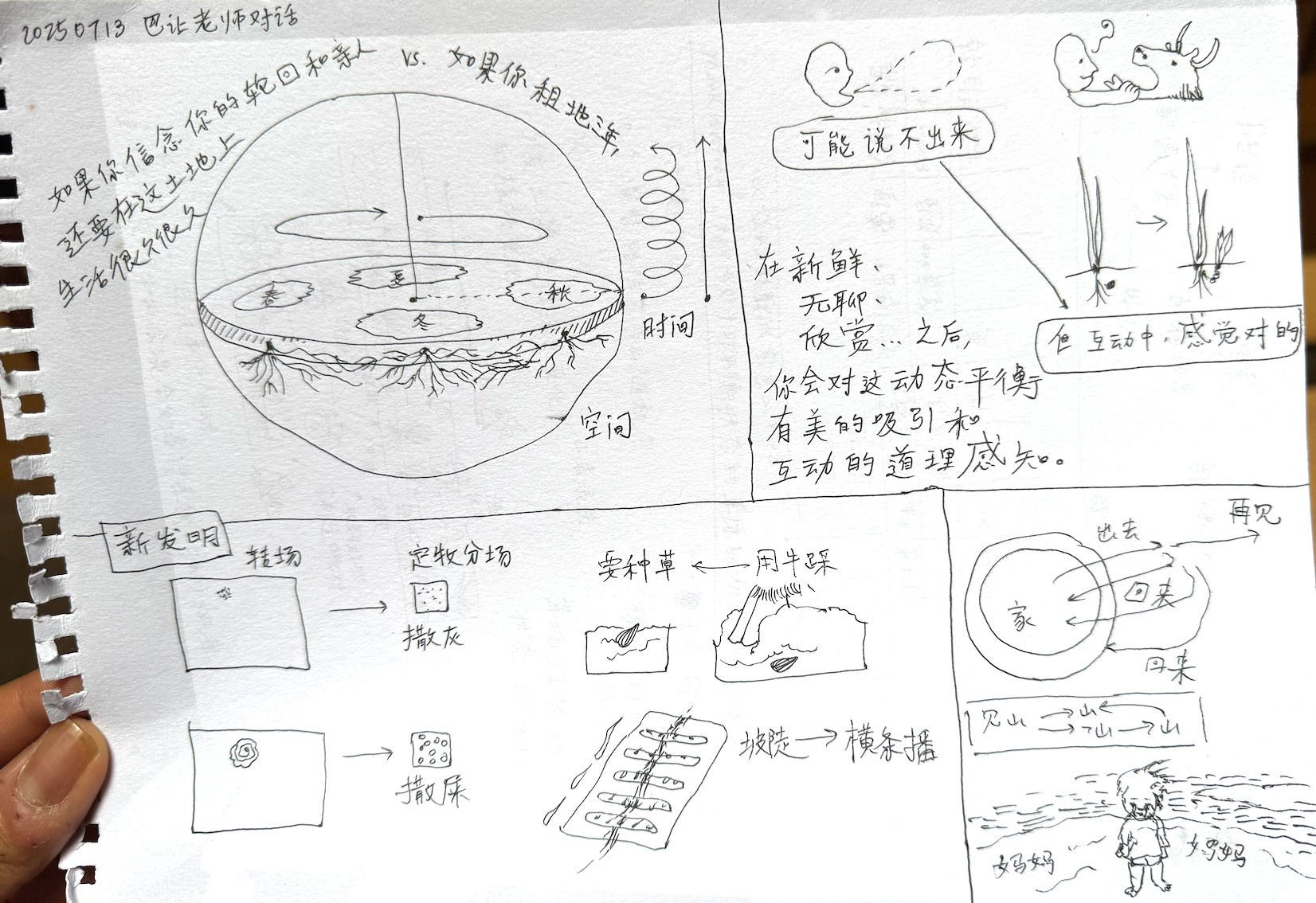
I had waves of nervousness - before going to ShangReEr, before talking to Palsang/presenting, before going to Maqu. I think I am getting closer, with the 4 themes emerging that carry emotional as well as pragmatic and rich intellectual motivation. The four themes are: mental models, animal agency via trampling, commons tactics, and how nonequilibrium management can work.
Mental Models
The most revealing interviews came from comparing herders of different ages and experience levels. Ershu, now 47, started herding at age 7 when adults put him on a horse because they didn't want to herd anymore. His older brother was chosen to inherit the silversmith trade, so he was selected to inherit herding. He couldn't get down from the horse until dark when he returned home, learning by following neighboring grandfathers.
His emotional connection runs so deep that he'd rather eat one meal less to take his animals to the freshest grass in the morning. He takes pride when his autumn animals sell for higher prices than others, and the next year he gives other animals even better feed.
The contrast with his younger brother Zhezhe, who started herding in his teens, was striking. Their herding styles are completely different. Ershu uses less supplemental feed, buying dried grass instead of commercial feed because he thinks it makes animals rely less on fresh grass for weight gain. He maintains diverse livestock (sheep, cattle, and horses) while Zhezhe focuses purely on sheep because they mature faster economically.
Ershu used to rent premium pastures near Gire sacred mountain, expensive but the animals would grow fat and even become picky about regular grass when they returned. If they sold well, he'd treat his animals even better the next year. Zhezhe doesn't rent additional pastures.
There are other differences in style. For example, animals could get infectious diseases from waters and grasses or the weather. The deaths from diseases impact herder livelihood a lot a lot. While Zhezhe would use vaccines and medicines from the government, Ershu is more conservative in that he doesn’t give treatment as much and early, and he prefers traditional medicine rather than new medicines. There are also daily life efforts that can reduce diseseases. At Maqu which is filled with wetlands, they mentioned how in autumn they try not to let cattle and sheep drink wetland water because it doesn't circulate and causes illness. The practical knowledge about water, soil, and animal health is so specific and important.
The emotional difference was most striking. Ershu truly loves his animals deeply. He' will go hungry himself to ensure they get the best morning grass. Many people aren't willing to work harder and be more diligent to let their animals eat better. This might be because he started so young while others learned later when families already had someone to inherit herding responsibilities.
Tingting asked whether their different approaches related to whether they experienced collective versus divided pasture management. Since Shangreer only divided grassland this February, both experienced collective management, but the 7-year age gap and different starting ages shaped their mental models differently.
When I told Shutu there's so much I could model here - even the frequency process of people coming to the ecological cultural center - he said "do what you want to do the most." I said there's been so many moments of tears, surprise, resonance in the days past, and I recorded them. But I feel obstacles about reading through them all.
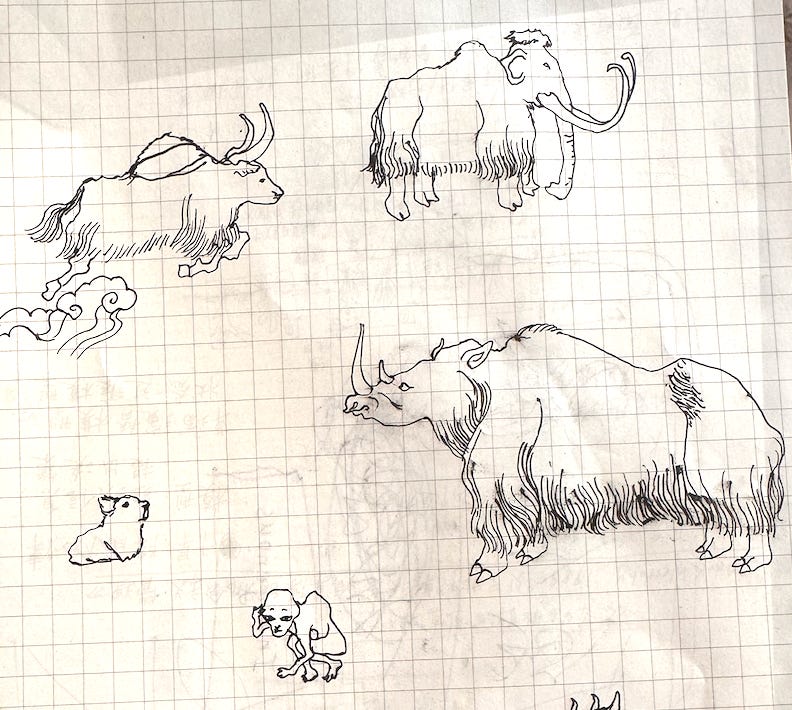
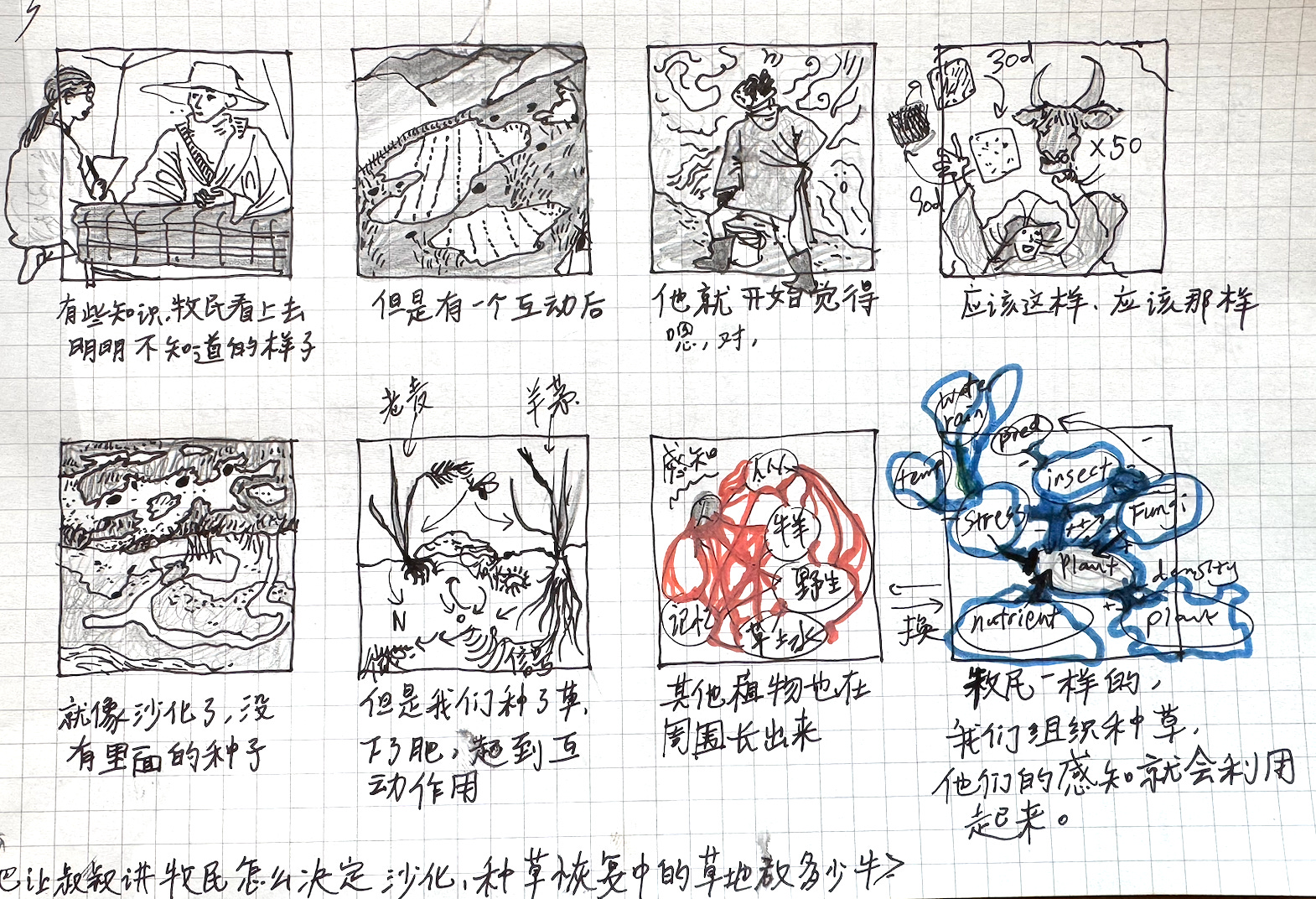
The living heuristics concept feels lovely. The multispecies system of herder-grass-herd(-wildlife) is beautiful. I feel safe in the thought that we are all learning to persist and adapt. The herders are biophysicists in that they understand how yak trampling affects seeds and vegetation. They control and shape how herds move in grassland to obtain desirable amounts of grass (sustained) and animal energy states. We should really learn how that works, just from the modeling perspective for more mechanisms to be elicited and translated to people who didn't learn from herders how herding works - a tangible implicit interactive knowledge.
Trampling
The animal trampling question kept surfacing across different contexts this week. During our conversation, Tingting said in the "the soil will save us" book, animal trampling of soil is good because it can break apart soil that otherwise might coagulate into large sheets which are harder to grow grass on.
But on the other hand, some herders say that sheep walk too much and break the soil/grass by walking so much.
Still yet, Palsang’s team use yaks to trample the seeds into the soil in the areas where grass is so sparse it turns to desert patches.
So what is it?
I think that if Prof Zhang (a soil and vegetation of grassland desertification researcher from Qinghai) follows through with the project to embed pressure sensors into the soil and see how exactly yaks unevenly trample to make the little soil beds for seeds, then come back to see how the grass growth pattern relates to this trampling, that would be good data.
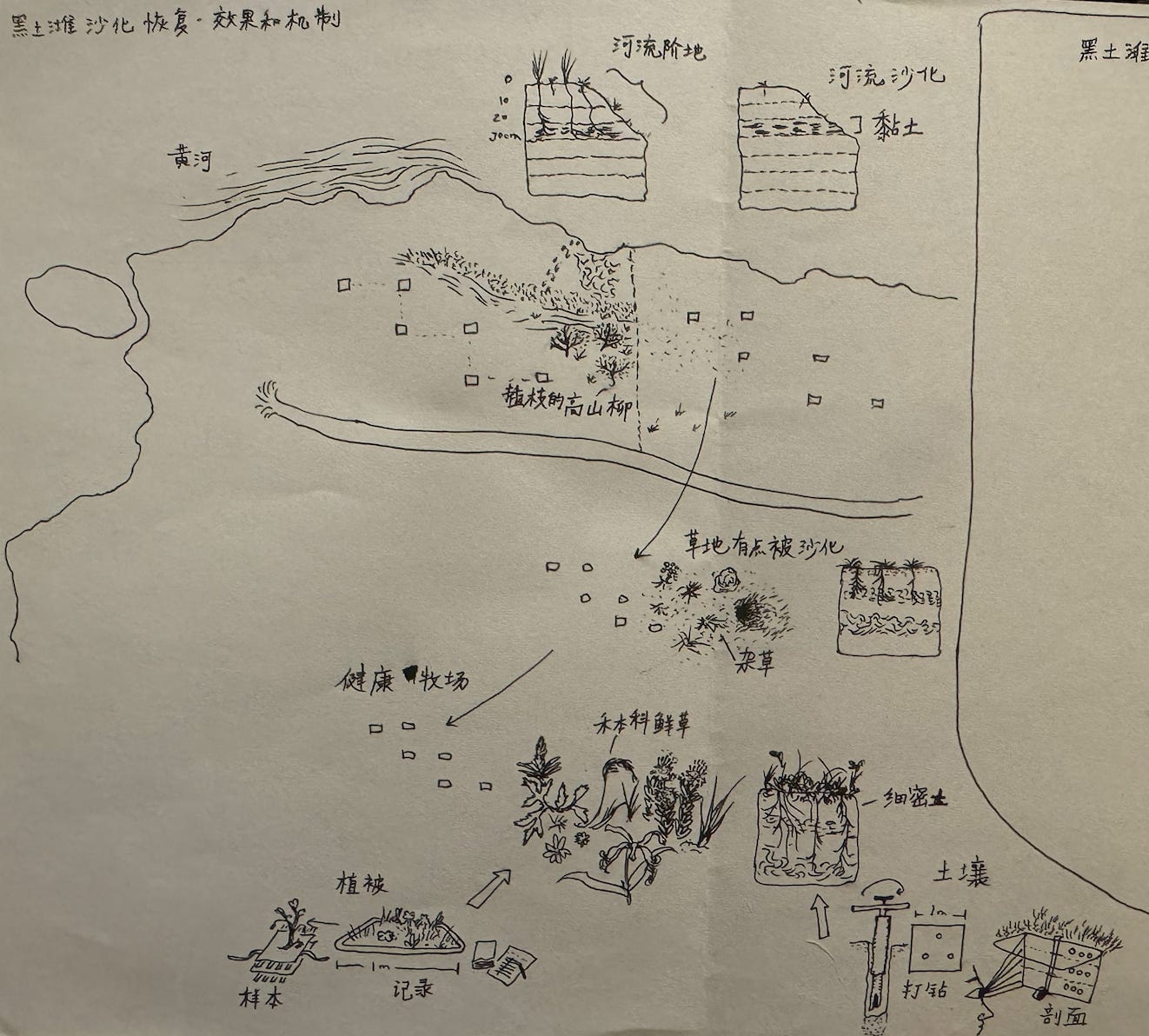
I think this is modelable - active walker, forcing between hoof and soil, effect on seed/plant - then predict macro pattern.
BUT I had some difficulty in asking herders about trampling. For example, even though Ershu is so expreienced and loving about herding, when I asked him about whether sheep trampling was worse than cattle, he said there wasn't much difference, contrary to what I expected from the literature. Maybe I didn’t ask it in the words that they think about trampling in?
Commons
Maqu gave me the chance to see collective pasture management in action. Awancang is a village that still practices collective herding, so I was curious how they decided not to divide grassland, or how after dividing, the whole village returned to collective management. With deteriorating grassland and increasing market pressure, how do they update their collective management methods?
During the interview, I learned they have 30 households sharing all seasons. No arguments about when to move pastures. People who left rent 300 mu at 200 yuan per cattle per year. In 2002, they allocated livestock numbers, and if births exceed deaths, the numbers don't change. If births are many, selling becomes unprofitable. If deaths are many, renting land becomes unaffordable. But they maintain unity - no stealing grass.
The comparison with Team 4, which divided their grassland, was telling. Why did Team 4 divide while Team 6 didn't? The limits keep shrinking: pre-1980 people could have 20 head, then 15 head, then 5 head after 2002. In 2021, the government said even the 2002 numbers couldn't be maintained.
At night in Shangrire pasture, I watched the most fascinating part of collective herding - how herders split sheep from multiple families that had mixed together. Each family head calls "ker ker ker" and the sheep gradually recognize their owners and familiar companions, slowly separating into three families. Tingting mentioned there was a draft environmental law open for suggestions, where top experts like Luzhi and Tibetan environmental NGO leaders discussed whether collective pasture might be better for environment and social bonds, and if so, could it be put into law. The conclusion was that enforcement and implementation was the harder part. The fences are up, market pressure is there, and mentalities are shifting. How do you go back?
The people who most want to divide grassland are those who least want to stay in pastoral areas. When grassland was collectively used, people thought horses ate too much and damaged grassland. After dividing, people paid more attention to what actually affects grass and discovered sheep cause more damage through trampling.
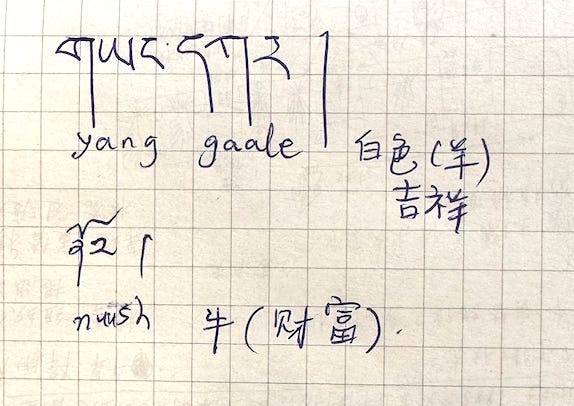
The tragedy of commons discourse came up repeatedly in conversations with Tingting, and later with Ellie and Thiago. With Ellie and Thiago it was about how the tragedy of commons is wrong and Elinor Ostrom's managing the commons is better because it involves 8 rules - the community has rules that are reasonable for the community itself, and commons need to be monitored. Commons don't run on good will, but on accountability.
Nonequilibrium
I was excited when I found the book "Nonequilibrium, Commons and Locality: New Thinking on Grassland Management" in the office.
The first article was about nonequilibrium ecological systems, with an introduction by Zhang Qian: "Ecological Foundations of Grassland Management: Integration of Equilibrium and Nonequilibrium Ecosystem Theory." This book articulated what I really wanted to say and do.
The policies to address grassland degradation over the past decades (reducing grazing livestock numbers and artificial grass planting) haven't been very effective based on evidence from 1999 to now. This might be because they assumed grassland is an equilibrium system. In statistical physics, an equilibrium system is a closed system where energy is conserved.
But these policies ignored several key points. First, the interaction between plants and animals isn't purely negatively correlated - sometimes livestock can help vegetation grow through light disturbance, like when cattle trample grassland and tall grass gets pressed down so new grass can grow. Second, there's evidence that livestock-vegetation relationships are affected by grazing historical time, and this historical time doesn't exist in equilibrium systems - it only exists in open, semi-open nonequilibrium systems with such complex relationships.
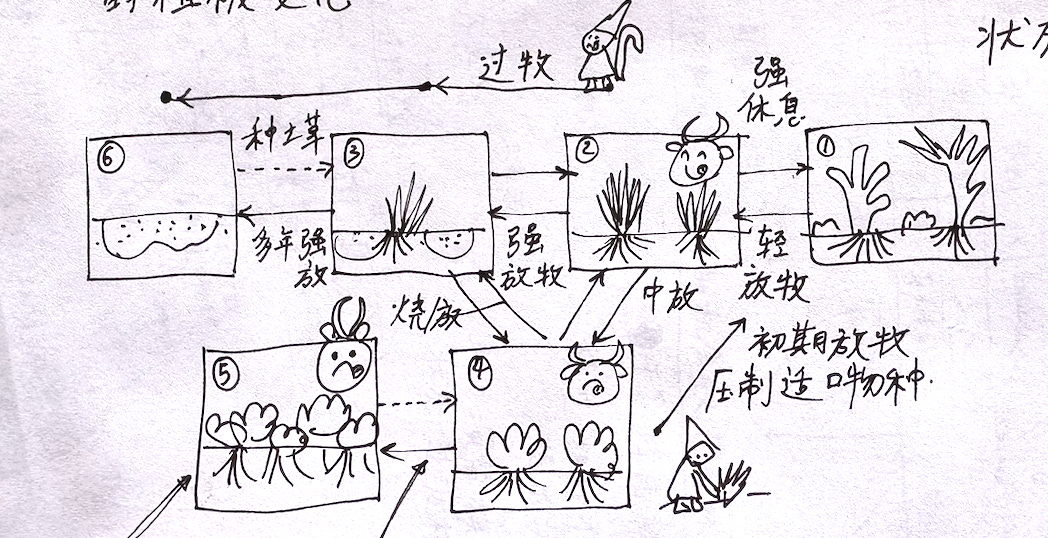
When Tingting and I discussed this, It was a bit hard to explain what nonequilibrium means and is useful for. I pointed to characteristics such as having multiple steady states - complete desert, half desert, and what else? - that could stay for some time whereas the "hills" in the energy landscape would quickly go to another situation. But I had trouble explaining what the book was actually meaning.
Tingting asked what nonequilibrium management would look like differently. I pointed to traditional methods of expanding/moving areas that actually fit the theory better than settlement and herding within fences. But that's quite obvious, so what other applications, predictions, suggestions can we make? Tingting said maybe I could partner with an on-ground team long-term. For example, I make suggestions, they test them out, they tell me what they want to monitor.
The Fernandez-Gimenez 2001 paper on Mongolia provided empirical grounding. They found that in arid, highly variable ecosystems, abiotic factors like precipitation have greater influence on vegetation biomass than grazing. But in moist, constant environments, grazing plays a greater role. The picture of ecosystem response is much more complicated than either model suggests.
During conversations about climate, I was surprised that herders didn't emphasize irregularity or randomness in weather patterns as much as I expected. They mainly talked about feed and pika problems, and human factors like grassland division. They said this year was windy, the rainy season came late, summer was short - but these things people can't change, you just watch the sky, and it doesn't change their herding methods.
Synthesis
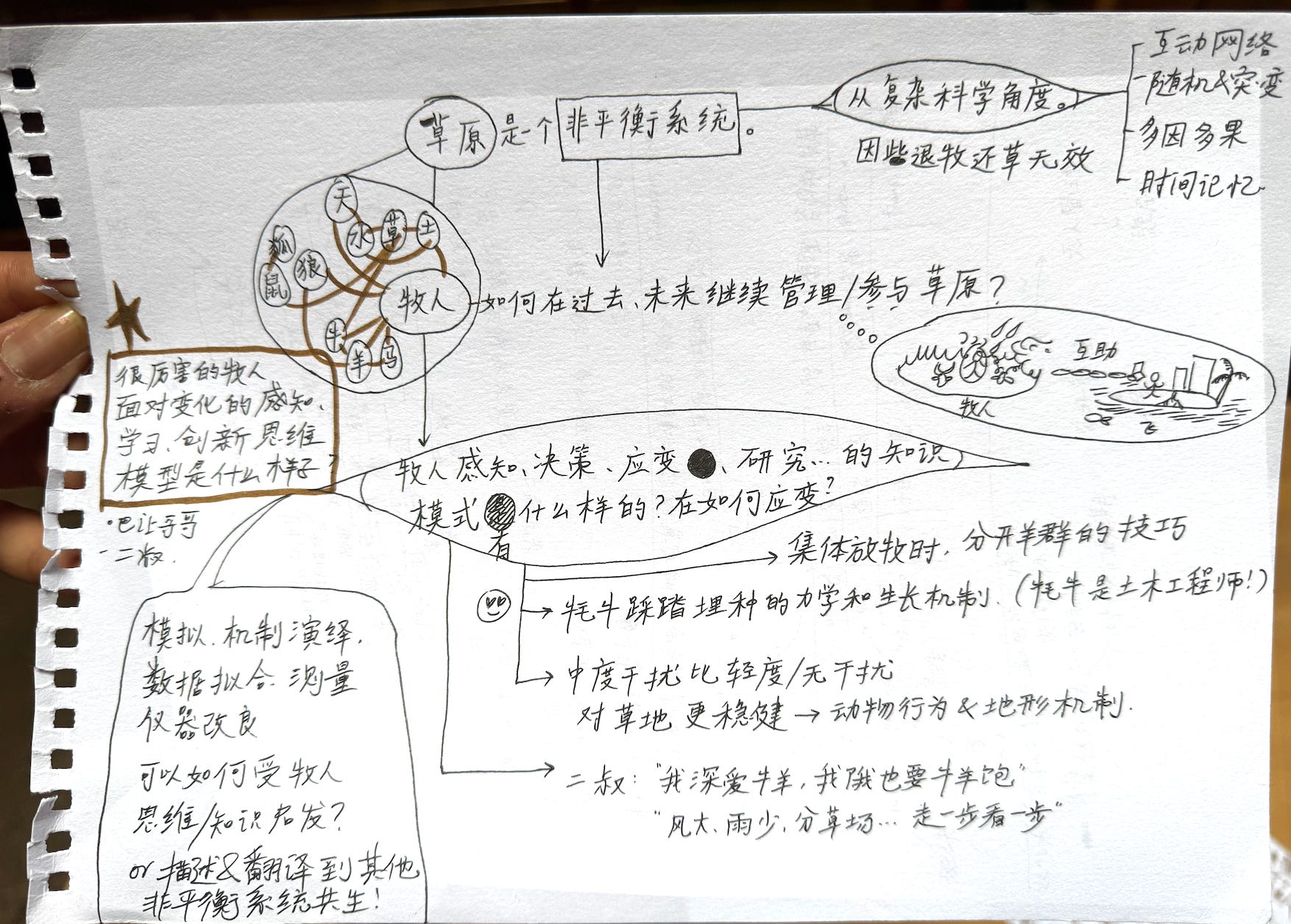
After Tingting went through my mindmap, we discussed more on each point I found possibly modelable. The animal trampling effect on grass and soil, the interference and state transitions where sometimes moderate interference is better than no interference, the collective pasture techniques and mentalities.
We talked about how to make this research mutually beneficial. Like continuing research that supports me while what I do has dissemination meaning for them, or certain descriptive and proposal significance. Yesterday when going to black soil patches with Zhang laoshi, some ideas emerged - like the yak hoof seed-burying mechanism they consider successful research that could be refined into a model or data. Sheep separation is like a game that could be simulated, though simulation itself might not have practical use, but it's something that must be done during collective herding.
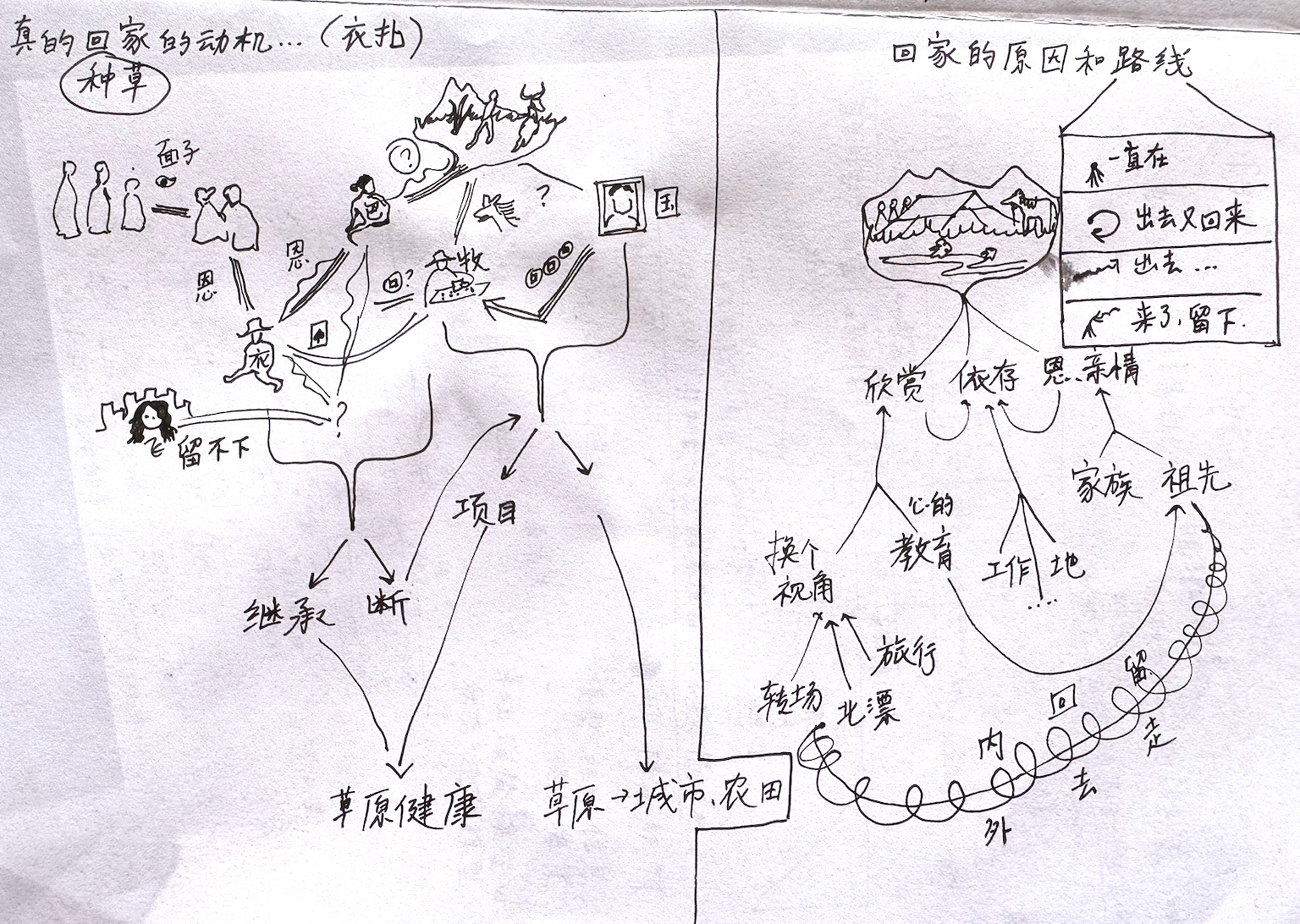
Tingting asked about the narrowness of research direction when I mentioned yak trampling and sheep separation. I'm not looking for narrow research directions - I'm most interested in the worldview and thinking perception patterns of people who have insight about herding, who patiently observe and adjust herding methods. Like Tingting said, many indigenous organizations now link themselves with environmental protection, but their sacred mountain work doesn't completely equal environmental protection - they're different concepts. So don't directly impose your own concepts on others' worldviews, but understand different ways of seeing the world.
What I feel most curious about is a holistic view of an experienced and loving herder. Their goals, decision-making methods, how they innovated during times when grass was sufficient and during droughts and disasters. From the perspective of people I know who do scientific modeling, humans manage grassland, animals shape grassland like engineers, humans use their understanding of biological and physical interactions to manage grassland.
They have deep knowledge of animal characteristics - how they walk, graze, and move in groups. How does grass grow? What happens when grass is trampled? How to predict unpredictable weather systems? Including the people in temples who calculate weather systems - how do they calculate? Is there scientific rationality in this? Why does dividing grassland and creating scenic areas weaken helping relationships between people? Why do different people always have different emotional connections to grassland?
The qualities of wanting to stay in pastoral areas: patience, gentleness, observation and perception of nature and surroundings. These are the mental models I want to understand and learn from.