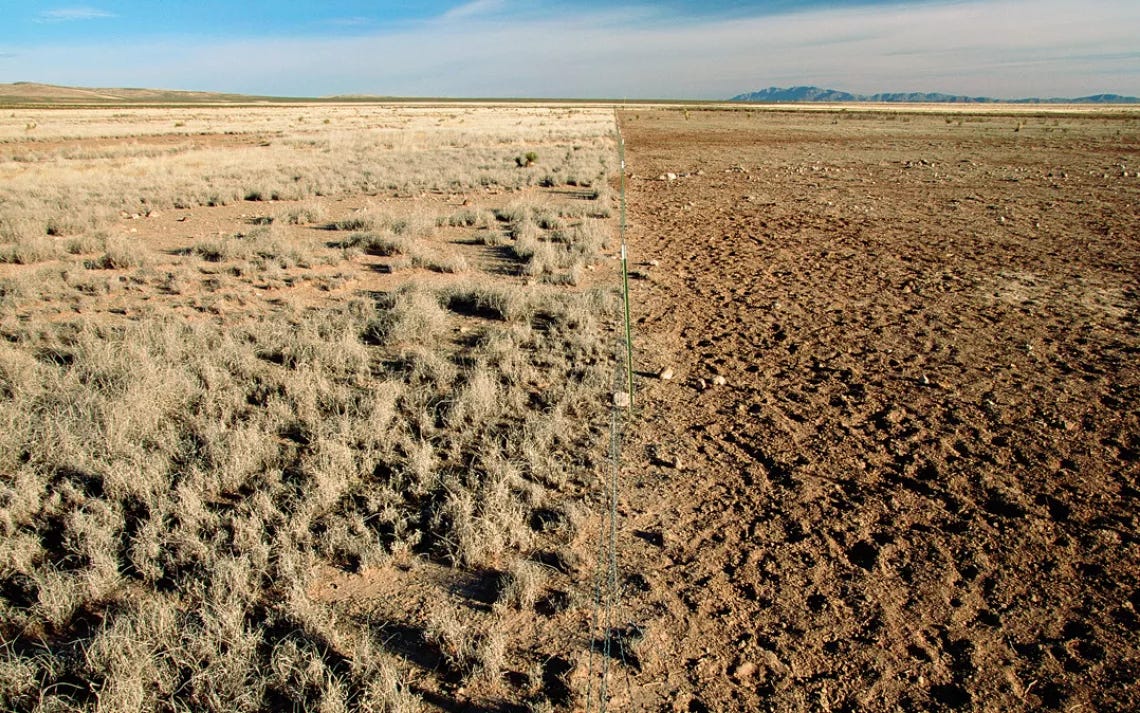
How do hoofs sweeten soils?
Beyond the Savory debate, what can let pastoralists and grasslands both thrive?

The lore
When I was researching about desertification solutions on the Tibetan plateau, the story that fascinated me the most was about how, in contrast to the state and expert and 20th century claim that pastoralists’ animals overgrazing is the blame for grassland degradation, actually when replanting grass on deserts animals could help in the grassland recovery.
“in contrast to the state and expert and 20th century claim that pastoralists’ animals overgrazing is the blame for grassland degradation” because there are still policies up to today, for about 40 years now, called 退牧还草 stop herding to recover the grass. These policies subsidize or mandate herders to limit their animal amount or stop grazing in a region completely (like a protected area) in the assumption that without overgrazing or with less grazing, the grass will naturally recover to the better ecological state that is diverse in species, dense in coverage, and robust in soil and water circulation.
The herders of course have their motivation to say that animals are good or not bad for the environment. They want to keep the herding lifestyle. The story of adaptation is about the herders who are working on their own on treating the degraded grasslands. Most grassland treatment projects from the past 40-50 years are government projects. They typically involve animal reduction and natural recovery. The herder treatment includes grazing, but also in a new style compared to normal grazing on grasslands that are healthy. Their grazing method is different from just letting animals roam, but a careful management. (Perhaps more like traditional grazing before market incentivized fencing and stocking.)
The story reads:
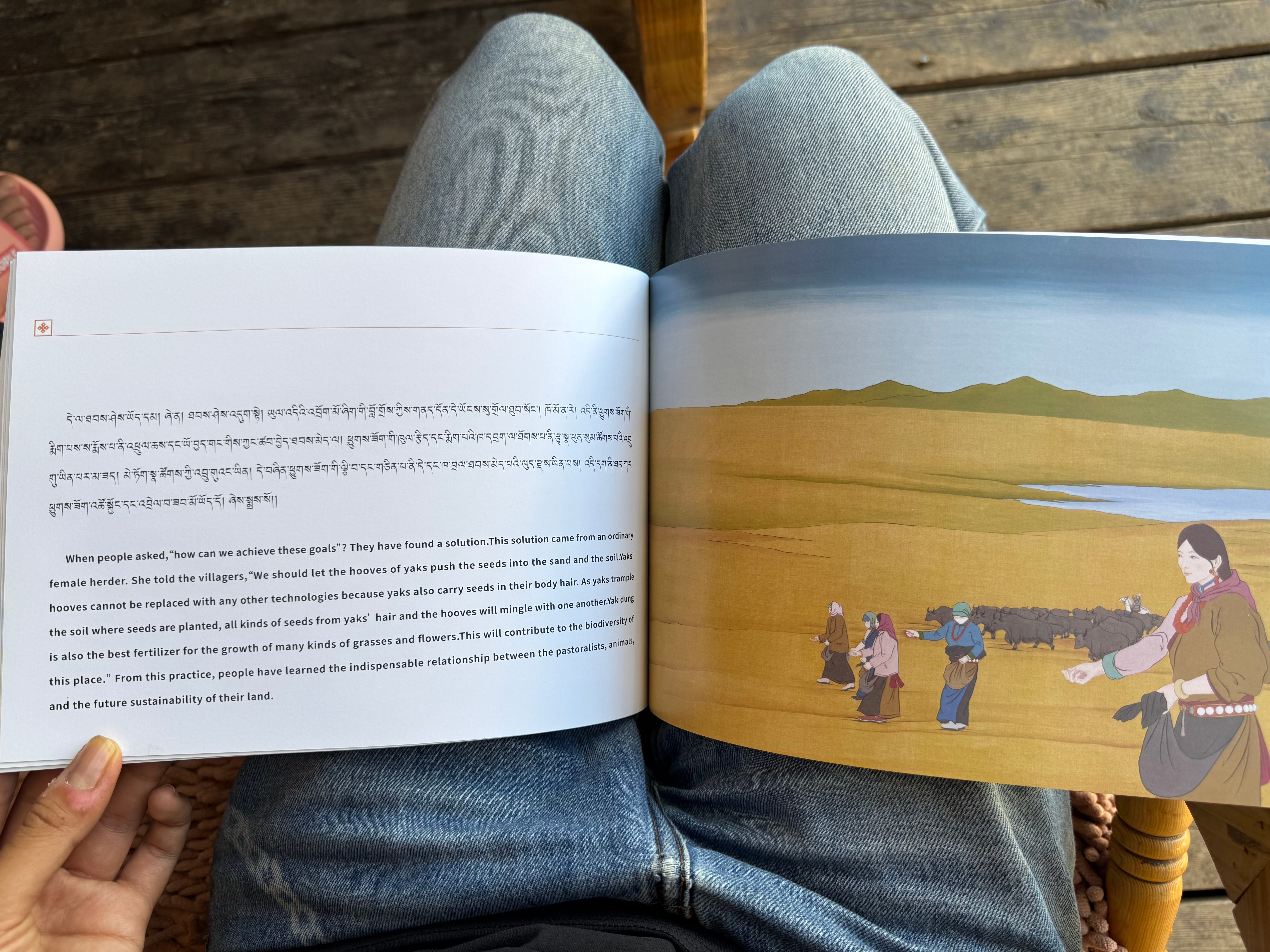
When people asked, “how can we achieve these goals?” They have found a solution. This solution came from an ordinary female herder. She told the villagers, “we should let the hooves of yaks push the seeds into the sand and the soil. Yaks’ hooves can be the best (frugal) technology because yaks also carry seeds in their hair. As yaks trample the soil where seeds are planted, all kinds of seeds from yaks’ hairs and hooves will mingle with one another. Yak dung is the best fertilizer for growth of many kinds of grasses and flowers. This will contribute to the biodiversity of the place.” From this practice, people learned the indispensible relationship between the pastoralists, animals and the future sustainability of their land."
When I asked who this herder is, Yizha said they don’t know. I suspect it’s a story technique but the hooves and seed carrying do work so that’s ok with me.
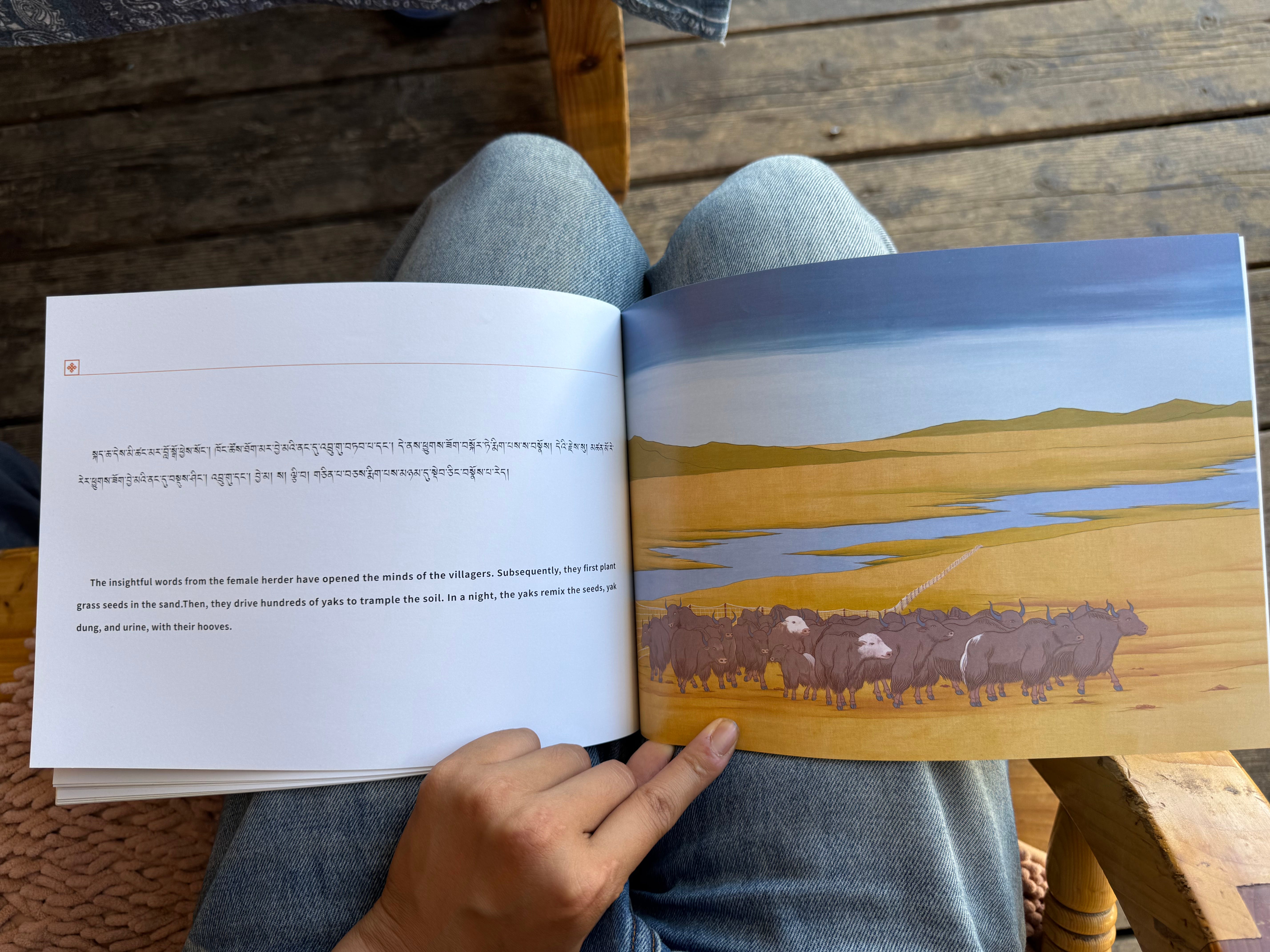
During replanting, the pasture is banned from grazing except in the spring when the soil melts. The one-year fast grasses have grown tall while the multi-year grasses are just beneath the surface, protectetd by the shade of the tall grasses. The pastoralists let a moderate amount of yaks into the pasture for a moderate amount of time, not maximizing on feed amount but more on grass health.
The yaks go in,
eat the leaves of grass (carbon gets sent back to the roots for stronger growth, and tall grass gets eaten more to allow species succession),
tramples with their hoofs over the old tall grass so that the new short grass has more sun (to photosynthesis and succeed as the new dominant or diverse species) and the old grass is a protective layer on the soil to prevent water erosion (slipping away without absorbing into the soil),
poops and pees (feeding the soil and soil microbiome with nutrients),
trample also over soil sheets (breaking the large dried sheets apart for more air and space for soil-microbiome clumps to form, water to stay in the soil in the little holes as puddles, instead of flow away on the surface).
In conclusion, having a moderate not too little not too much grazing intensity in a set season corresponding to grass growth is good for degraded grasslands in their transition to healthy grasslands. The outcomes that are measurable include soil coagulation, soil water retention, soil fragility or humility, grass biodiversity, grass coverage compared to bare soil, soil microbiome…
OK these points about which yak behaviors produce which beneficial outcome for soil and grass is a compilation of what I heard from Tachung Tsang and the book “The soil will save us”.
What is the limitation?
First I’m not sure how much case studies and scientific summaries we have of the alternative method (grazing-included degraded grassland remediation).
Second what is the exact mechanism that could be replicated for improved outcomes. E.g. the each year adjustments about how many cows, when, how long, where.
What is next? Global conversation (Allan Savory, rangeland management)…